Your website
Your website has one job.
Get someone who needs the work doing to pick up the phone and call you. Everything else on it is decoration. I build websites for plumbers, electricians, builders, landscapers and other local service businesses around that one job.
In short
What should a trade website actually do?
A trade website should tell someone within seconds that you do the job they need, in the area they live, and then make calling you one tap away. It should load fast on a phone on poor signal. Everything beyond that is decoration.
The problem
Most trade websites fail for boring reasons.
It is rarely the design. It is almost always one of these four, and all of them are fixable.
It takes too long to load
Someone standing in a flooded laundry will not wait eight seconds. They go back and tap the next result.
The phone number is buried
If they have to hunt for it, or pinch and zoom to tap it, you have lost them. It should be the easiest thing on the page.
It does not say where you work
People search with a suburb in mind. If your site never names the places you cover, it never answers their actual question.
It talks about you, not the job
Paragraphs about passion and quality workmanship. Nothing about whether you do the specific thing they need doing.
Recent work
Sites built for people who work out of a van.
Different trades, different problems, all built by me. Open one on your phone if you get a minute, because that is where your customers will be looking at yours.
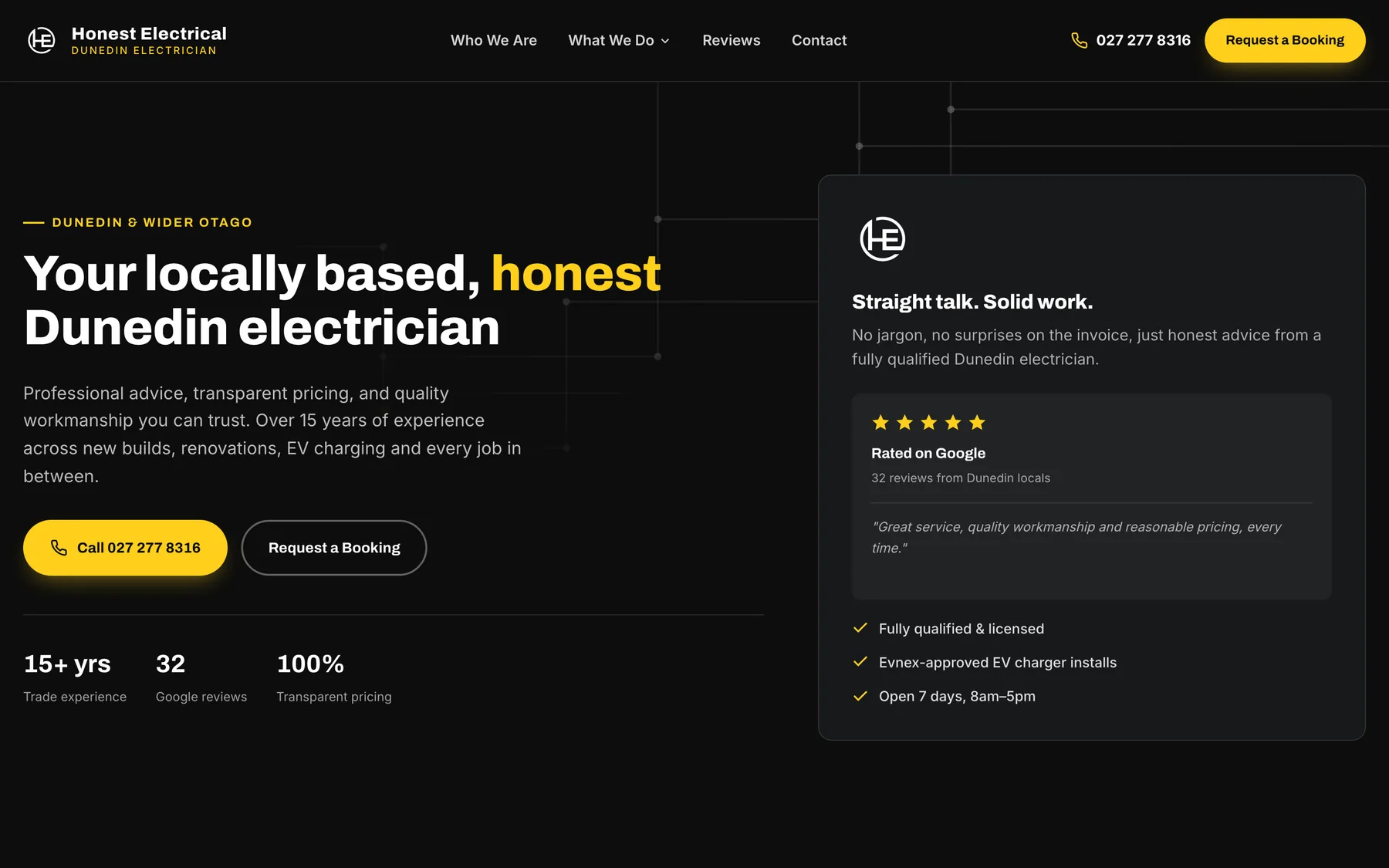
Honest ElectricalElectrician, DunedinA dark, straight-talking site for a Dunedin electrician whose whole pitch is no surprises on the invoice. His number, his Google reviews and his qualifications are all on screen before you scroll, so nobody has to go hunting for a reason to trust him.
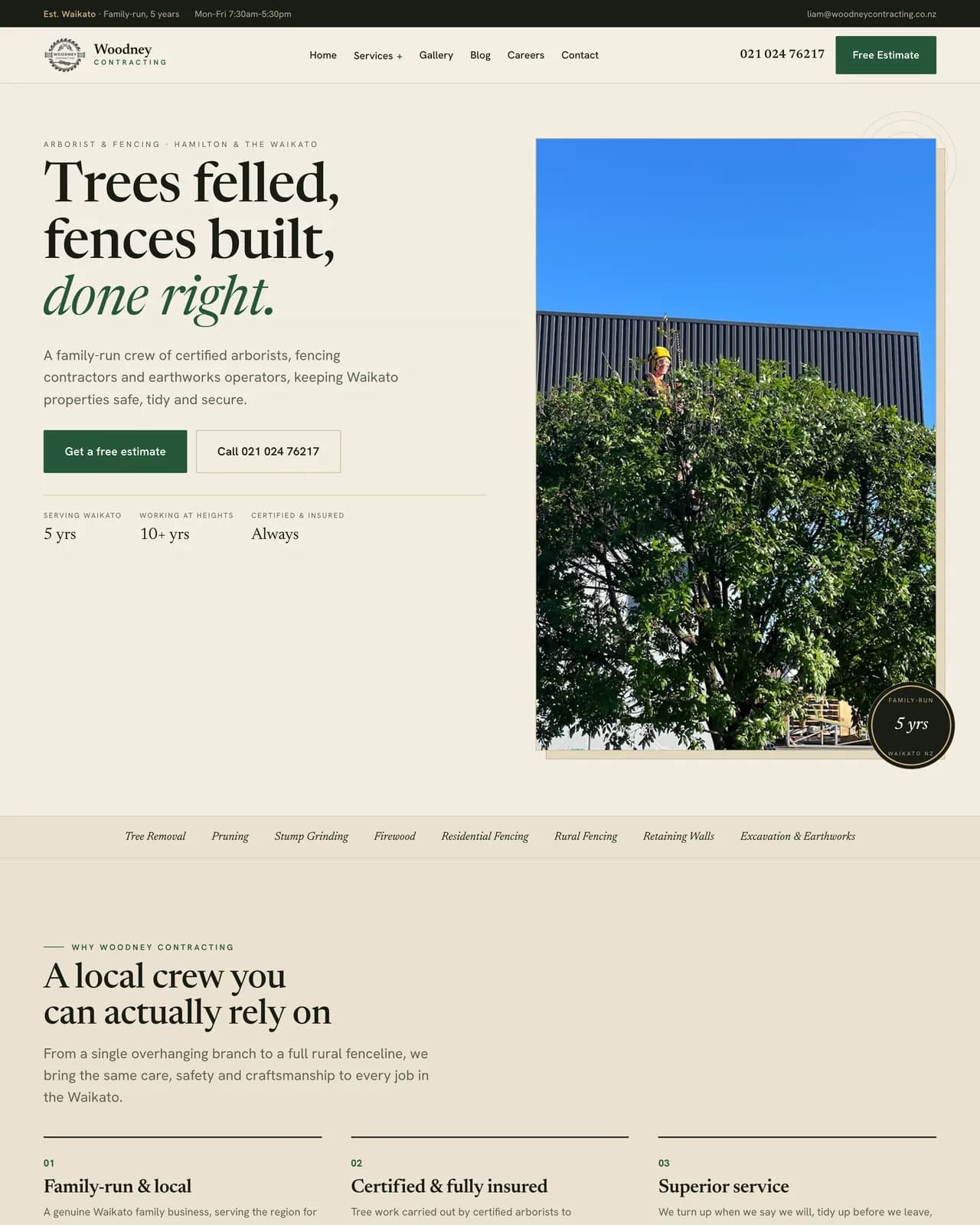
Woodney Contracting
Arborist and fencing, Waikato
A family-run Waikato crew doing two different trades, tree work and fencing, from the same business. Each trade gets its own set of pages so neither gets buried, and the site still reads as one company rather than two.
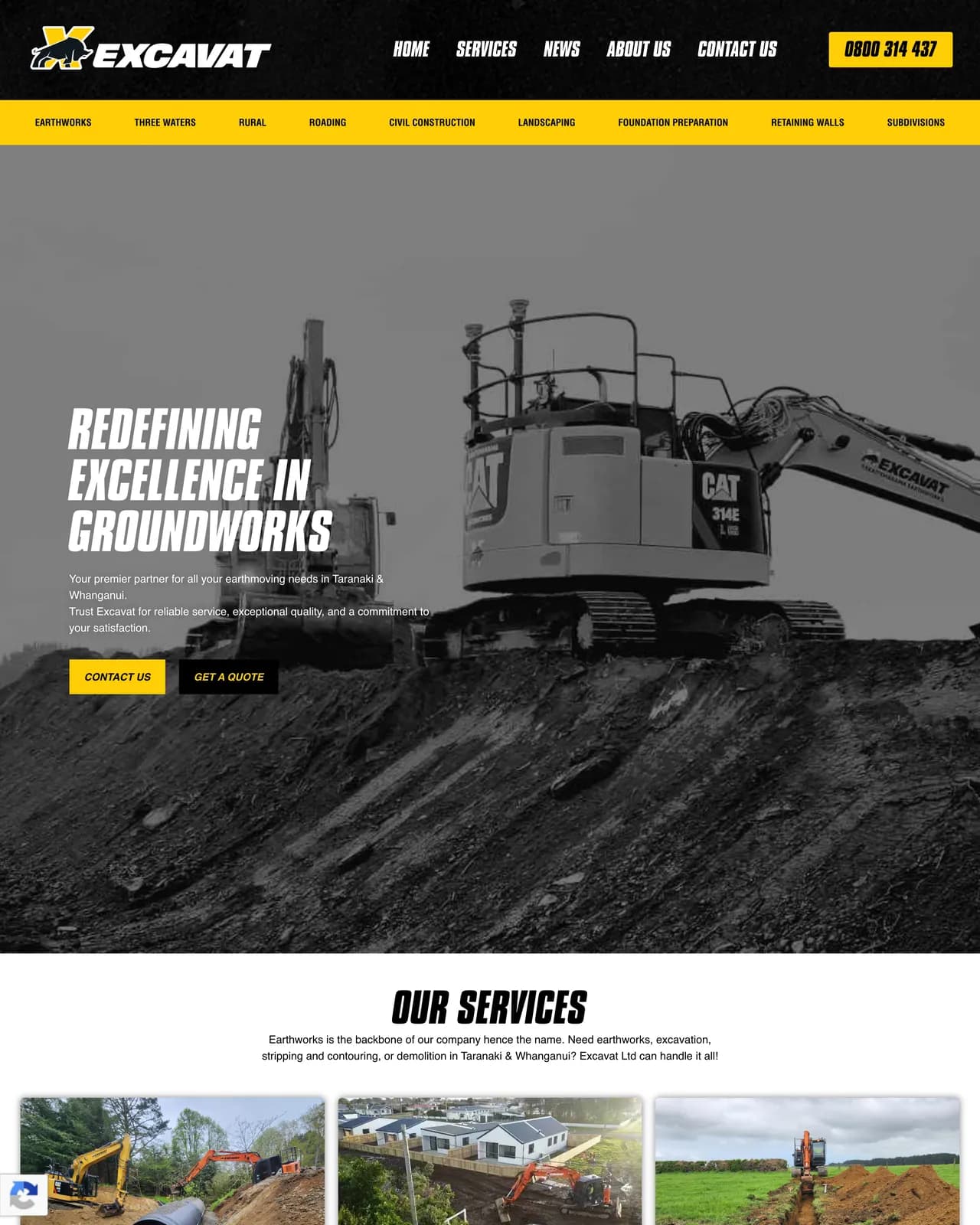
Excavat
Earthmoving and civil, Taranaki
An earthmoving and civil contractor covering everything from three waters to subdivisions. The machinery is what convinces people, so the photography leads and each service sits on its own page underneath it.
What you get
What is actually in it.
Every web design job here includes the same things. There is no cut-down version and no upgrade path, because a website missing any of this does not work.
- Built for a phone first
- Most of your customers will find you on a phone, often outdoors, often in a hurry. That is the version I design first, not the one I check at the end.
- Your number where a thumb lands
- One tap to call, one tap to message. On every page, not just the contact page.
- A page for each job worth having
- The work you want more of gets its own page, written the way a customer would describe it. That is also how people find you in the first place.
- The places you cover, named
- Your suburbs and towns spelled out properly, so a search with a place in it has something to match.
- Words that sound like you
- I will ask what you actually want to be called for, then write it plainly. No paragraphs that could belong to any business in the country.
- Set up so Google can read it
- Titles, headings, page structure and the technical bits done properly at launch, so the work to get you found later starts from a clean base.
- Accounts in your name
- Domain, analytics, Google Business Profile. Registered to you, not to me. Hosting sits on my setup, which is how it stays quick, but the site is yours and leaves with you if you ever want it to.
How I build it
Four steps, and you know where you are at each one.
- 01
We talk about the work
What you do, where you do it, which jobs you want more of, and which ones you would rather stop getting.
- 02
Words and structure first
What the pages are and what they say, before anything gets designed. Get this wrong and no amount of styling saves it.
- 03
I build it
Designed around your content rather than dropped into a template, checked on real phone sizes as it goes.
- 04
Launch and handover
Old links redirected so you keep whatever you have already earned, forms tested, and a walkthrough so you can make small edits yourself.
The honest bit
A new website on its own will not make the phone ring.
A brand new site with nothing behind it is a very tidy business card that almost nobody sees. Getting found on Google is a separate job, and Google Ads is the fast way to fill the gap while it builds. I will tell you upfront which you need.
It also will not fix slow quoting, an unanswered phone, or prices the market will not pay. I would rather say that on the first call than take the money and watch it change nothing.
EightySixOS Editor
Change your own site without opening the code.
A fast, well built site is no use to you if changing one sentence means finding the right file and deploying it. So any site I build can come with an editor in it. You see the words as they appear on the page, change them there, and publish with a button.
Put your call-out rate up. Swap in a photo from last week. Add the service you have started offering. None of it involves hunting through files, and none of it can break the layout around what you are editing.
It works on the site you already have rather than moving you into something else, and what it lets you touch is deliberately scoped. Rebuilding and restructuring pages stays my job, because that is where sites get broken.
It is part of EightySixOS Editor, the tool I build on the agency side.
What it costs
Work out a rough price.
Move the slider to however many pages you think you need. The figure updates as you go, and you get a fixed price in writing before anything starts.
Home, about, contact and one page per service is usually five or six. Not sure? Leave it and we will work it out.
- Website, first page$900
- 4 more pages × $300$1,200
To get started, one-off
$2,100 + GST
Hosting is $250 + GST a year and the first year is included. NZD. The build price is fixed in writing before anything starts.
Get an exact quoteThis is an estimate. Tell me about your business and I will give you an exact figure in writing.
Why is the first page more than the rest?
Because the first page isn’t really a page. It is the hosting set up, your domain pointed at it, Google Analytics and Search Console connected, the structure every other page hangs off, and the testing to make sure it all holds. That work happens once, whether you end up with four pages or fourteen.
Once that exists, another page really is a couple of hours. So you pay to build the machine once, then far less for each thing it produces.
Your domain is the one thing not included, on purpose. I would rather you owned it yourself, in your name, so nobody can hold it over you. I will help you point it at the new site.
Stu created our new website, super happy with the result. Stu has been super easy to deal with, accommodating and has gone above and beyond our expectations. We really appreciate your help and expertise and feel lucky to have found you.
Questions
Things people ask me.
How much does a website cost?
In New Zealand dollars, from NZ$900 plus GST for the first page and NZ$300 for each one after, so a five-page trade site comes to NZ$2,100 plus GST. Prices are set per country rather than converted, so the same site is £1,000 in the UK and US$1,220 in the States. The calculator above does the arithmetic.
How long does it take?
Usually a few weeks rather than a few months. The part that slows projects down is almost always waiting on photos and information from your end, so the more you have ready, the faster it goes.
Will I be able to update it myself?
Yes, if you add EightySixOS Editor. Day to day things are yours: prices, photos, text, and articles. Anything structural, like a new page or a change to how the site is laid out, comes to me. That split is deliberate, because structural changes are where sites get broken. If you would rather be able to build pages yourself, say so early, because that points at WordPress instead.
What do you build websites on?
Usually hand-coded HTML, because it is quicker to load, harder to break and cheaper to run. There are no plugins to update and far less to go wrong. The trade-off is that it is not the sort of thing you can log into and rebuild yourself, which is exactly why EightySixOS Editor exists: it gives you the everyday editing without the weight of a full content system. If you genuinely want to get in and build new pages yourself, WordPress is the better fit and I build those too, including Elementor. It costs more to look after, because plugins, updates and security need managing or the site gets slow and becomes a target. I will tell you honestly which one suits how you actually want to work.
I already have a website. Can you fix it instead?
Often, yes. Send me the address and I will tell you honestly whether it is worth fixing or whether you would spend less starting again. Either way you get a straight answer before you spend anything.
Will I lose my Google rankings if you rebuild it?
That is what redirects are for, and it is why I map old pages to new ones before launch. Rebuilds lose traffic when old links are dropped without redirects. That step is not optional on any site I build.
Do I have to sign a contract?
No lock-in. A website is a one-off piece of work with a fixed price. If you want ongoing help afterwards we agree what that covers and what it costs, and you can stop it whenever you like.
Back up to the calculator to price up your own.
By trade
Looking for your trade specifically?
Everything on this page applies whatever you do. Where a trade changes the advice enough to be worth its own page, there is one.
Weighing this up against the other two? Marketing for plumbers covers all three and which one to spend on first.
Worth reading
More on this, in plain English.
Let’s talk
Send me your website, or tell me you haven’t got one.
Either way you get an honest answer about what I would do first, usually within one business day.